


Ki.Sui Journal / Hair Care
How Often to Use a Hair Mask: What Your Hair Really Needs
How often to use a hair mask depends on your hair, not on the calendar. If it is dry, curly, coloured or damaged, use one every time you wash. If it is fine or gets oily at the roots, once or twice a week is enough.
In short. Research has not set a fixed frequency: what follows is professional salon practice. On dry, curly, coloured or damaged hair, use your mask every time you wash, for about 5 minutes. On fine hair or oily roots, once or twice a week is plenty. Once a week you can leave it on for longer, around 15 minutes. Always from mid-lengths to ends.
01 / Why it depends
Why There Is No Single Rule
We have not found any studies comparing different frequencies. The guidance you read everywhere comes from salon practice and from the instructions on the products themselves.
What research does explain is how a mask works. Its positively charged ingredients settle on the hair and reduce static and friction between strands (D’Souza and Rathi, 2015).
That effect is temporary. Proteins left on the hair, for example, wash out with shampoo and need reapplying, as a 2023 review by Fernandes and colleagues explains. Nor does a mask rebuild the fibre: on bleached hair, conditioning made it easier to comb without reversing the oxidative damage (Tham et al., 2026). That is why the right rhythm is the rhythm of your washes.

02 / The table
How Often to Use a Hair Mask, and for How Long
Find your hair type and read across. These are guidelines from the salon, not rules set by research.
| Hair type | How often | Leave on for |
|---|---|---|
| Fine or oily at the roots | Once or twice a week: a small amount, on the ends only | 3–5 minutes |
| Dry, frizzy or curly | Every wash | 5 minutes; 15 minutes once a week |
| Coloured | Every wash; a colour-depositing mask once a week | 5 minutes; the colour mask as the label says |
| Bleached or damaged | Every wash | 5 minutes; 15 minutes once or twice a week |
Why are 5 minutes enough? In the laboratory, the cationic conditioning agents used in conditioners reach equilibrium on the hair within 5 minutes (Tham et al., 2026). Small hydrolysed proteins are different: Fernandes and colleagues found they work better with longer contact. That is the point of the longer weekly session. For intensive treatments, D’Souza and Rathi describe 20–30 minutes. If your label says something else, follow the label.
Bleached hair needs it more. Bleaching strips away the outer lipid layer of the hair, which is why it starts to feel like straw. Conditioning makes it slippery again (Liu et al., 2022).
03 / How to apply it
Where to Apply It: Mid-Lengths to Ends
Hair wears progressively from root to tip (Gavazzoni Dias, 2015). On the ends of long hair, Fernandes and colleagues note, the cuticle can be missing altogether. So the mask goes on the lengths, in three simple moves.
- Blot after shampooing.
Press the water out with a towel so the mask does not get diluted.
- Work it in section by section.
Apply it through the lengths a section at a time, keeping it off your scalp.
- Rinse it out completely.
Gavazzoni Dias is clear on this: rinse-off conditioning goes on the lengths and comes off entirely.
04 / Know your products
Mask, Conditioner or Leave-In?
There is no official definition. In practice, the differences are easy to remember.
Conditioner
The lighter option. Studies describe it as an “instant” conditioner, suited to daily use on hair with little damage (D’Souza and Rathi, 2015).
Mask
More concentrated, for dry or damaged hair. In the same wash you need one or the other, not both.
Leave-in
You do not rinse it out. On curly hair it helps with detangling; on straight hair that has never been treated, it can look greasy and dull (Gavazzoni Dias, 2015). One example is Styling 10, applied to damp hair.
05 / Your mask
Which Mask Suits Your Hair
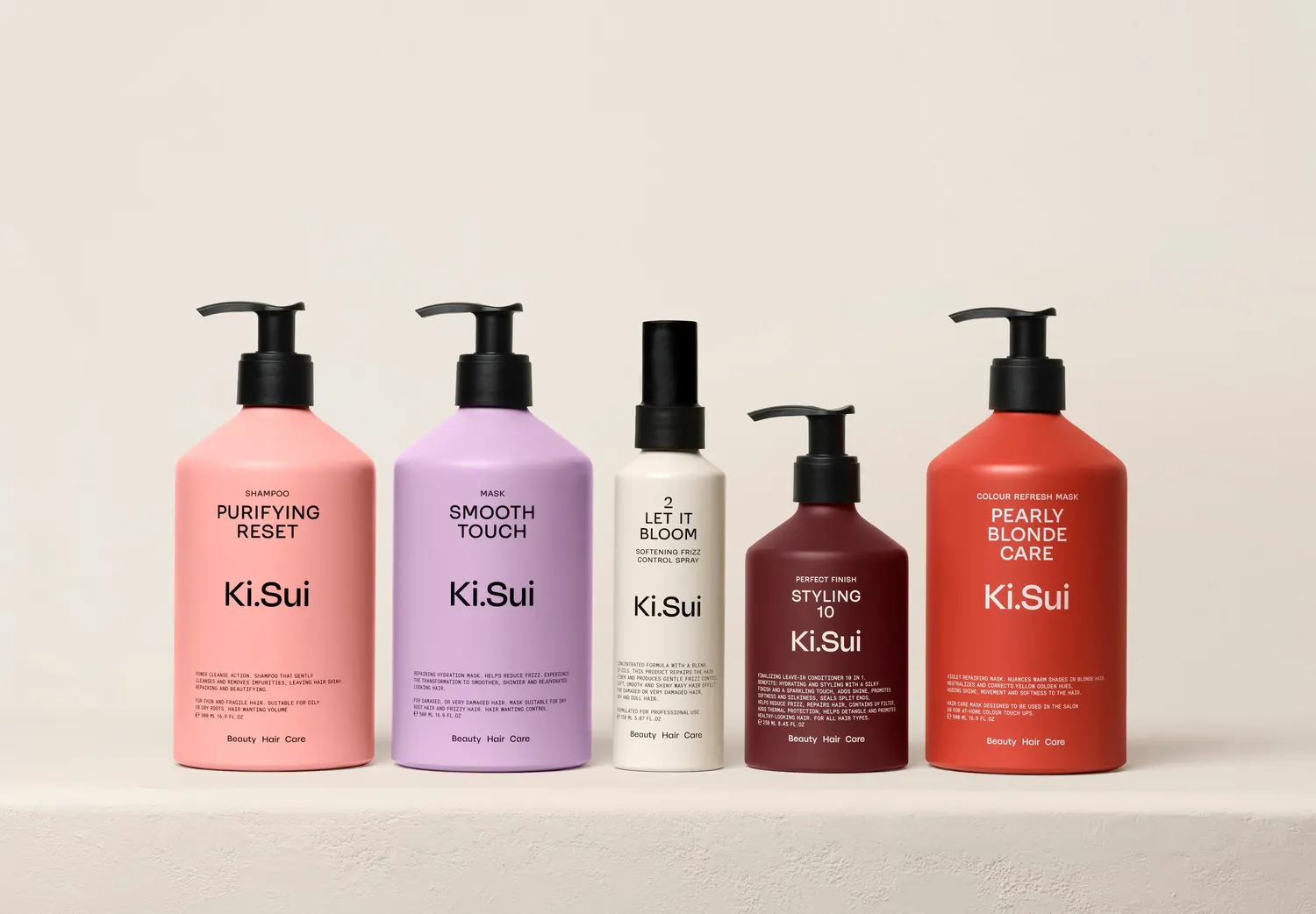
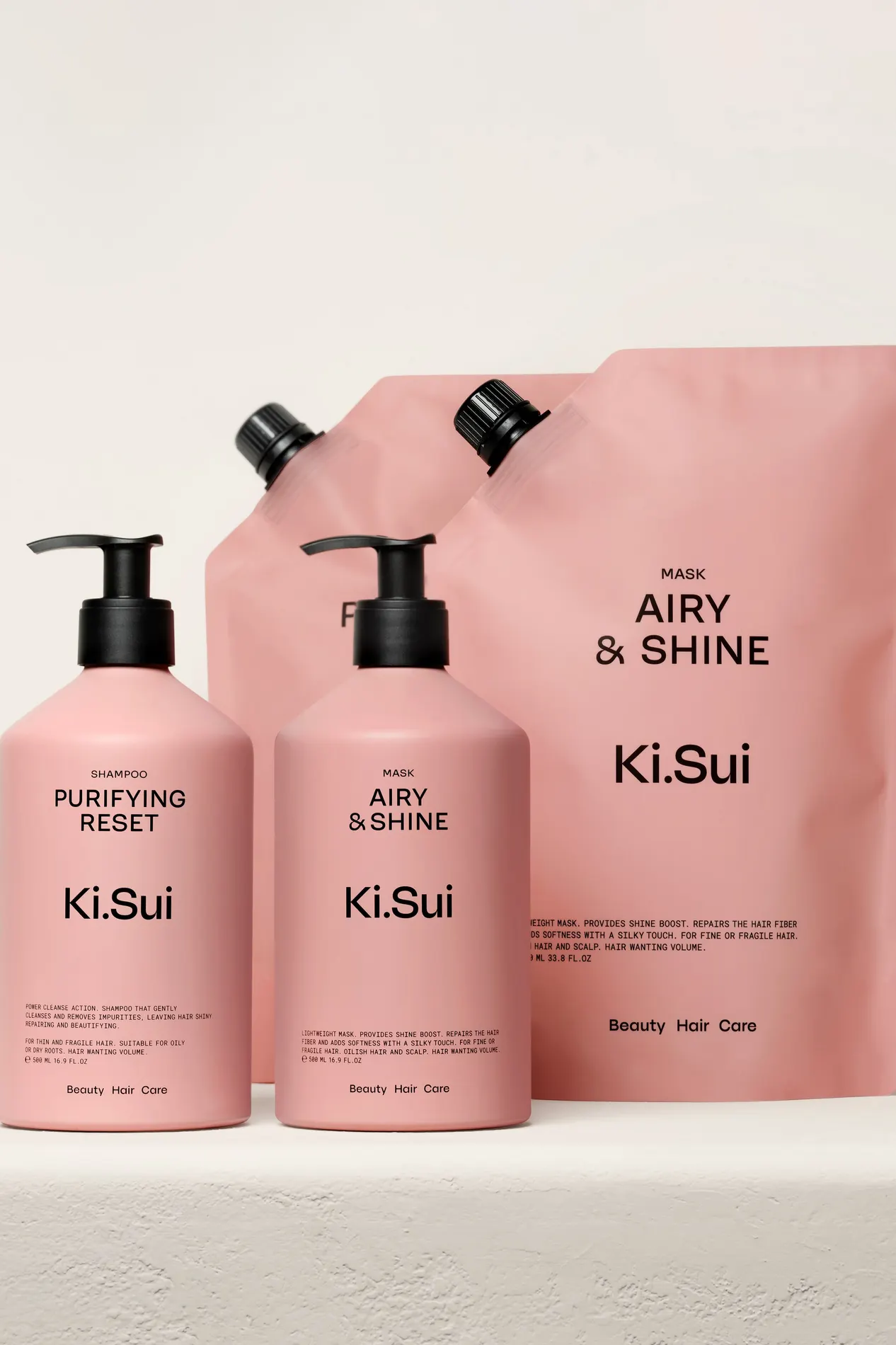
Fine hair or oily roots. Airy & Shine Mask is a volumising mask designed not to weigh hair down.
Dry or frizzy hair. Smooth Touch Mask is a nourishing anti-frizz mask. For this one and for Airy & Shine, the instructions say 5 minutes after every shampoo and 15 minutes once a week.
Coloured hair. The Colour Refresh masks. Pearly Blonde Care is violet and counters yellow tones. Platinum Blonde Care is black, for platinum blondes and grey hair. Brunette Illuminated Care is for brown hair. They are semi-permanent: use them once a week, for 15 minutes.
You will find them among the Ki.Sui hair masks, in 100 ml pouches, 500 ml aluminium bottles and 1 L refills.
06 / Getting the dose right
Signs You Are Using Too Much
Hair that is already flat the next day. Roots that get greasy sooner. Lengths that feel heavy and look dull. Thick films of oil leave hair looking greasy and weighed down, and some polymers build up and resist shampoo (Gavazzoni Dias, 2015).
The fix is simple: use less product, only on the ends, and leave more days between uses. If you use a lot of styling products, D’Souza and Rathi suggest a deep-cleansing shampoo once a week to remove the build-up.
If your hair still feels rough and frizzy, on the other hand, it probably needs more. Read more in Frizzy Hair: Causes and Remedies and, if it gets worse with the weather, in Frizzy Hair and Humidity.
A routine made for you
Not Sure Which Mask Suits You?
Answer a few questions about your hair and scalp and get a personalised Ki.Sui routine.
Take the Free Hair Diagnosis →07 / FAQs
Frequently Asked Questions About Hair Masks
Can I use a hair mask every day?
Yes, if you wash your hair every day and it is dry, curly or treated. If it is fine or oily at the roots, you risk weighing it down. A conditioner is the better choice, or a little mask on the ends only.
Does a hair mask go on before or after shampoo?
After, on towel-blotted hair, and then you rinse it out. The same goes for anti-yellow masks, unless the label says otherwise.
Can I put a hair mask on dry hair?
Rinse-off masks are designed for wet, towel-blotted hair. We have not found studies showing any advantage on dry hair, so follow the label.
Can I leave a hair mask on overnight?
We have not found studies showing any benefit beyond the recommended time, and cationic conditioning agents settle on the hair within a few minutes. On fine hair, all you risk is weighing it down.
Is conditioner or a mask better for fine hair?
Conditioner is the lighter of the two, suited to daily use on hair with little damage. If your hair is fine or oily at the roots, keep the mask to once or twice a week: a small amount, on the ends, for 3–5 minutes.
Research & Further Reading
- D’Souza and Rathi (2015). Shampoo and conditioners: what a dermatologist should know? Indian Journal of Dermatology, 60(3), 248–254.
- Gavazzoni Dias (2015). Hair cosmetics: an overview. International Journal of Trichology, 7(1), 2–15.
- Fernandes, Medronho, Alves and Rasteiro (2023). On hair care physicochemistry: from structure and degradation to novel biobased conditioning agents. Polymers, 15(3), 608.
- Tham et al. (2026). Electrokinetic analysis reveals common conditioner ingredient interactions with human hair. International Journal of Cosmetic Science, 48(2), 379–393.
- Liu, Graf, Hub and Kellermeier (2022). Effects of cosmetic emulsions on the surface properties of Mongolian hair. ACS Omega, 7(13), 10910–10920.

